



Surface hardening
表面淬火与化学热处理
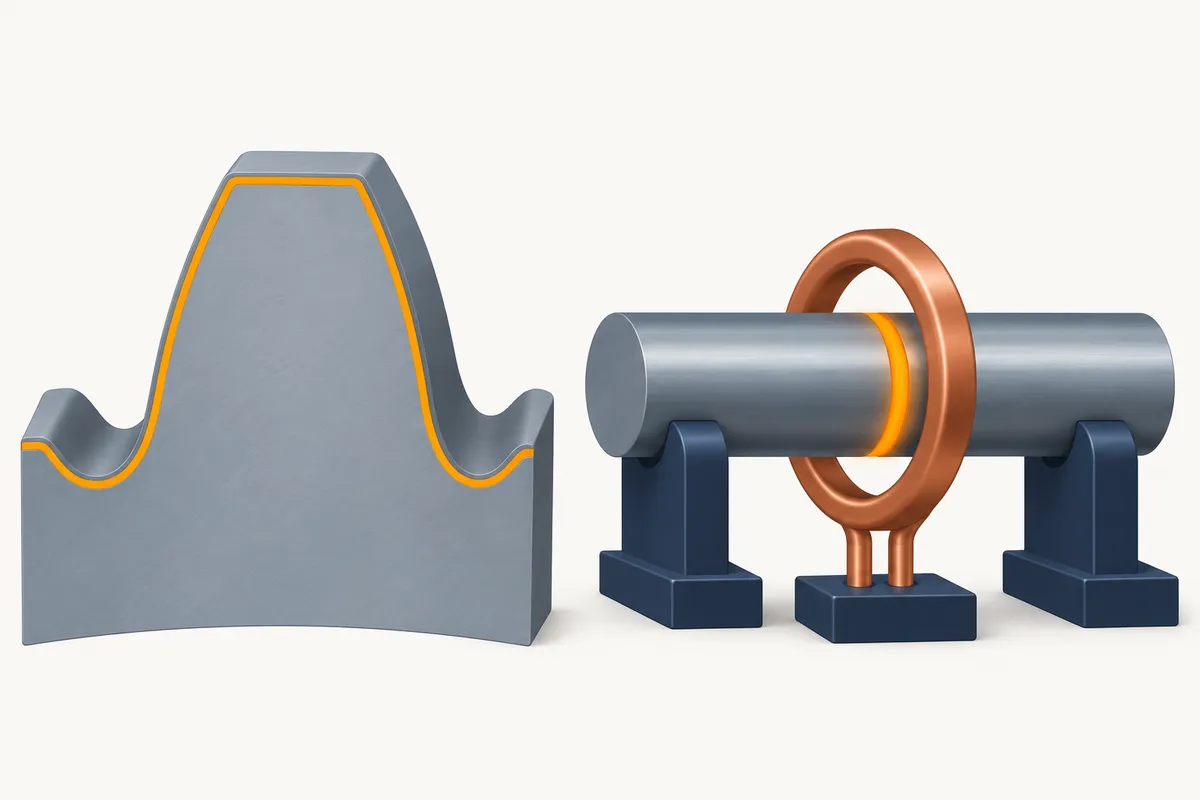
In plain words
Some parts need a hard skin and a tough inside: a gear’s teeth must not wear, but the gear must not crack either. Only a thin outer layer is hardened, like the glaze on a clay pot, then the hard faces are ground to size.
What it is
Some parts need a hard, wear-resistant skin over a tough core, such as gear teeth, shafts at their bearings and cam faces. Carburizing (渗碳) soaks low-carbon alloy steel in a carbon-rich atmosphere so the skin can be quenched hard, typically to a case of 0.5 to 2 mm at about 58 to 62 HRC. Nitriding (渗氮) diffuses nitrogen in at a lower temperature, around 500 to 570 °C, for a thinner hard case with little distortion, so it can come after finish machining. Induction hardening (感应淬火) heats only a band or a tooth with an induction coil in seconds and quenches it, on medium-carbon steels. Areas that must stay soft for later machining are masked. The usual route is: machine with allowance, harden, then grind the hardened faces (136).
Why it matters for products
The treatment named on the drawing, with its case depth and hardness, sets the order of operations, the grinding allowance and an outside process with its own lead time.
Learn first
Making a part like this? Plan the process and estimate costs in Workspace.