



Aging: stress relief and age hardening
时效处理
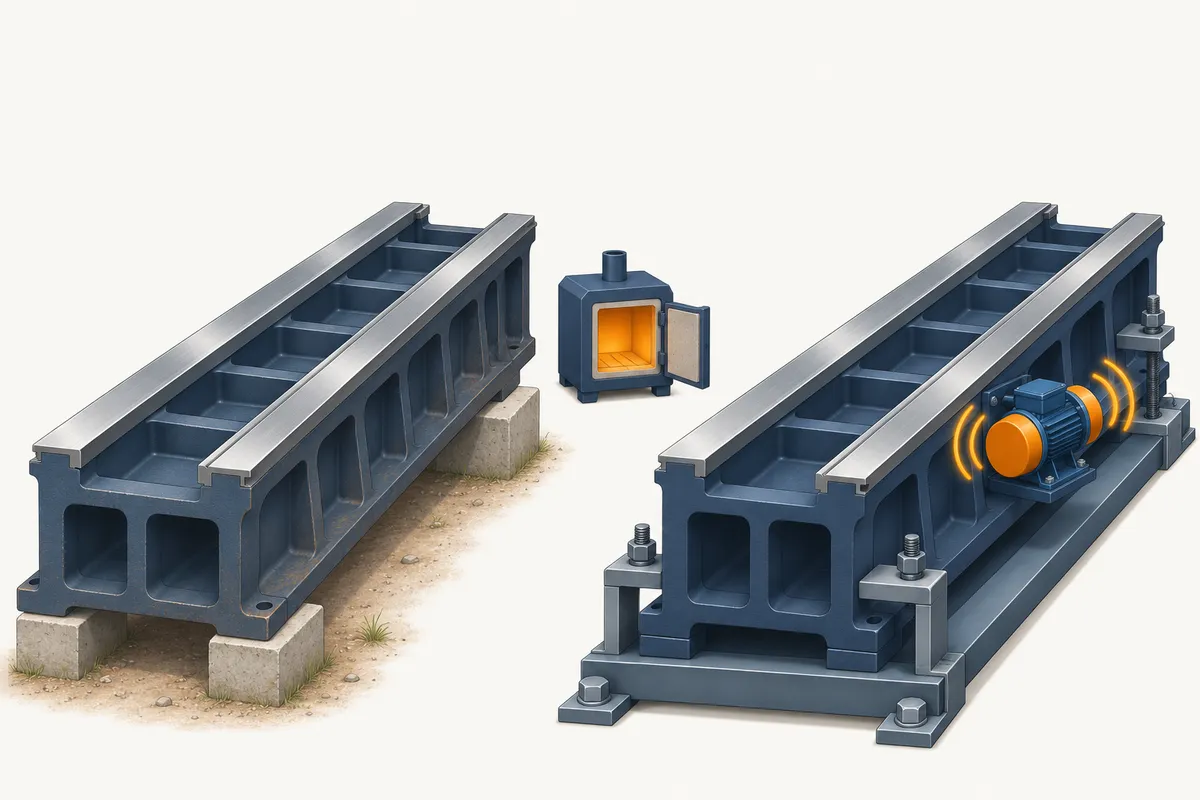
In plain words
Metal that has been cast, welded or cut hard is full of hidden tension, like a bent ruler held straight by force. Aging lets it relax before the last cuts, by resting it for months, warming it gently in an oven or shaking it, so it moves much less afterwards. A different kind of aging bakes some aluminium and stainless alloys in an oven for hours to make them stronger.
What it is
Two different treatments share this word. Stress-relief aging lets a part give up the stress locked in by casting, welding or heavy roughing (86) before it is finished, so it does not move afterwards. Natural aging (自然时效) leaves castings to stand for months; thermal aging (人工时效) heats the part slowly in a furnace, holds it at a moderate temperature and cools it slowly; vibratory aging (振动时效) shakes it near its resonant frequency, with no furnace. Precise and heavily cut parts follow the route rough, age, semi-finish, finish. Age (precipitation) hardening instead makes certain alloys stronger. Aluminium in the T6 temper has been solution treated, quenched and then held at a modest temperature for hours. 17-4PH stainless steel is often machined in its solution-treated condition and aged afterwards at a few hundred degrees, which hardens it and shrinks it by roughly 0.05 to 0.1 percent, so finished sizes allow for that.
Why it matters for products
An aging step between roughing and finishing belongs in the routing of castings, weldments (150) and large, thin parts, often bought in by weight or furnace load; temper codes such as T6 belong in the material table (167).
Learn first
Making a part like this? Plan the process and estimate costs in Workspace.