



Conventional machine tools
普通机床:车、铣、钻、刨、插
In plain words
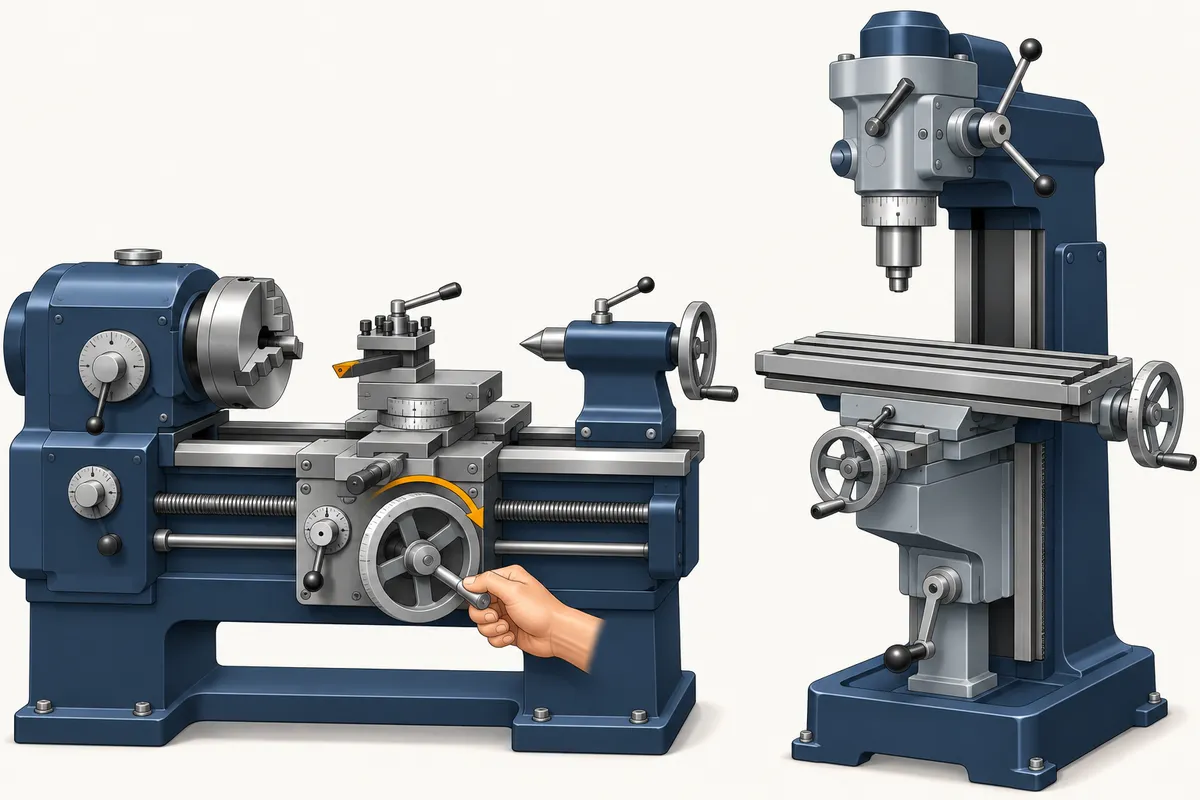
Before computers drove machines, a skilled person turned the handwheels, like drawing freehand instead of printing. Many workshops still keep manual lathes, mills, drills and planers for simple jobs, repairs and one-off parts. They are cheap to run, but the result and the time depend on the person at the wheels.
What it is
Next to the CNC machines, many shops, especially in China, still run conventional machines worked by hand. The manual lathe (普车) and the knee mill (普铣) do simple turning, facing, slots and one-off repairs; the radial arm drill (摇臂钻) swings its head over large parts to drill and tap big flanges and plates. The shaper (牛头刨) and the larger planer (龙门刨) cut flat faces and grooves with a single-point tool: on the shaper the ram carries the tool back and forth, on the planer the table carries the part, and the slotter (插床), a shaper standing on end, cuts keyways inside bores. The operator turns handwheels, reads dials or a digital readout and measures between cuts, so skill sets both accuracy and time. The Chinese phrase 车铣刨磨钻 (turn, mill, plane, grind, drill) names this traditional mix. These machines cost little per hour but use more labour per part.
Why it matters for products
A real machine list mixes CNC and manual machines with different hourly rates, and manual operations are timed from standard times (108), not from a toolpath.
Learn first
Making a part like this? Plan the process and estimate costs in Workspace.