


Non-traditional machining
特种加工:电解、化学、激光与超声加工
In plain words
Not every shape is best cut with a sharp edge. Some processes dissolve metal with electric current in salty water, eat it away with chemicals through a stencil, burn tiny holes with a laser, or chip at glass and ceramic with a vibrating tool and fine grit. Each wins in its own corner: very hard metals, very thin sheets, very small holes or very brittle materials.
What it is
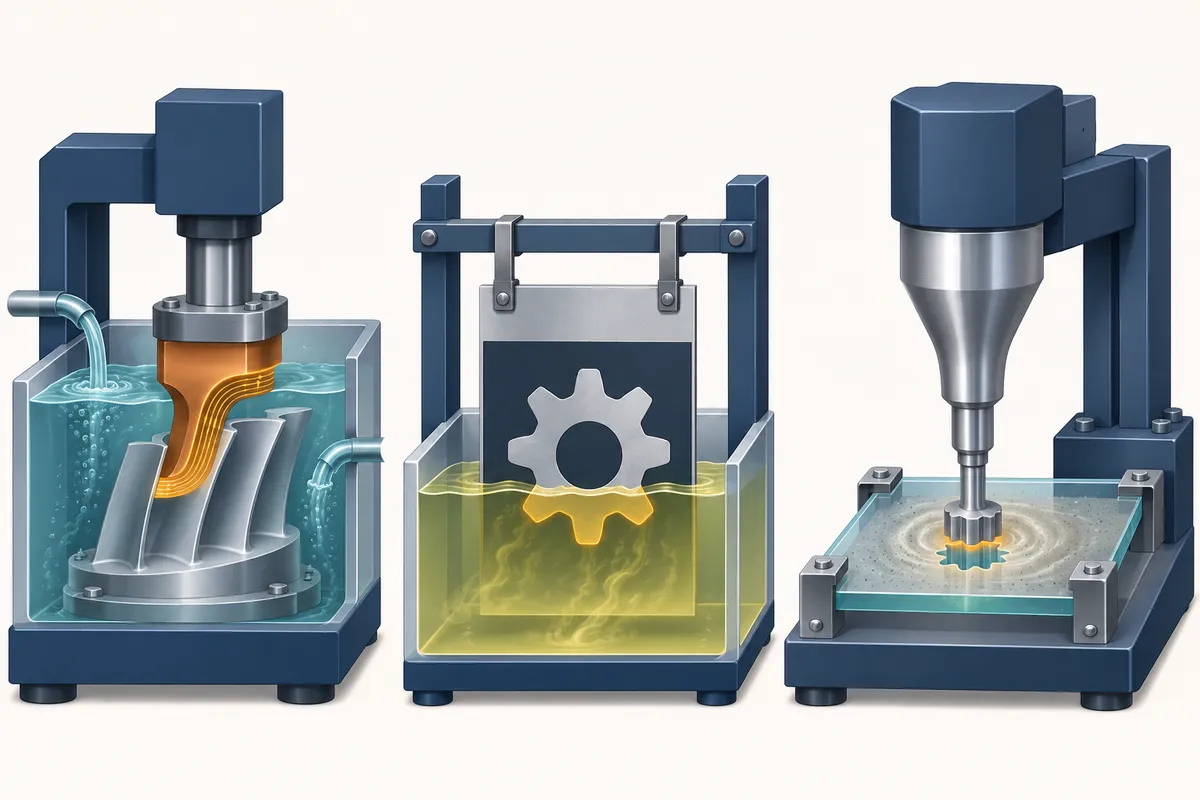
Some work suits neither a cutter nor EDM (84). Electrochemical machining (ECM) pumps a salt solution through a narrow gap between the part and a shaped tool and passes a current, so the part dissolves into the tool's shape; the shaped tool stays clear of the part and wears very little in normal use, and the part gets no heat damage or stress: turbine blades, gun-barrel rifling, and the deburring of crossing holes inside valve bodies. Chemical milling masks a part and etches the bare areas in a bath, to thin large aerospace skins; photochemical etching uses a photographic mask to make thin flat parts such as shims, meshes and springs without burrs or stress. Laser drilling burns small holes quickly, including the angled cooling holes in turbine blades, and lasers also texture surfaces. Ultrasonic machining vibrates a tool many thousands of times a second over an abrasive slurry and chips away at glass, ceramics and other hard, brittle materials. Most job shops buy these as outside services.
Why it matters for products
Process selection beyond milling, turning and EDM needs rules for when each wins, such as brittle non-conductors, tiny holes in superalloys, thin flat parts in volume and burrs inside crossing holes.
Learn first
Making a part like this? Plan the process and estimate costs in Workspace.