



Laser cutting and CNC punching
激光切割与数控冲床
In plain words
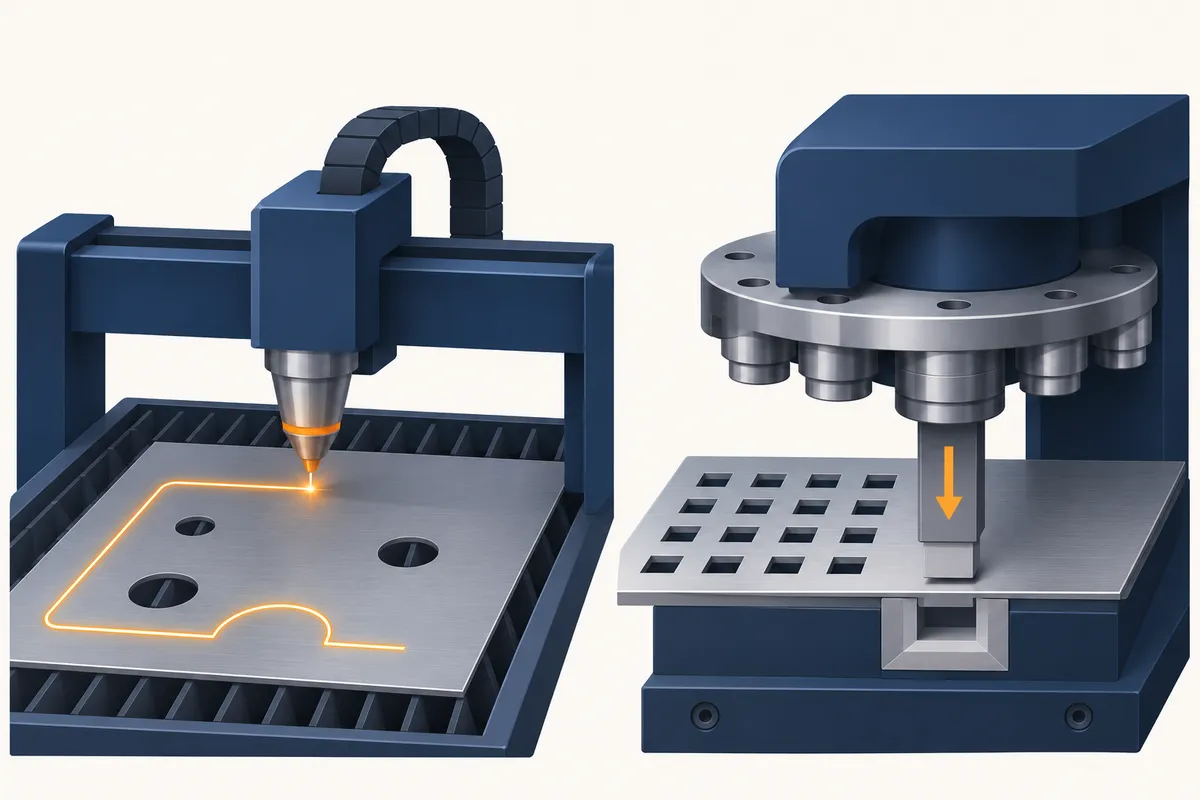
A laser beam focused to a point thinner than a pencil line melts a path through the sheet and a gas jet blows the melt away, so it can follow almost any outline. A punch press stamps a hole in one quick hit, like a paper hole punch, which is faster when the same hole repeats many times.
What it is
A fibre laser cuts outlines and holes from the sheet by melting a narrow kerf, a few tenths of a millimetre wide, and blowing the melt out with gas: oxygen on mild steel for speed, nitrogen for clean, oxide-free edges on stainless steel and aluminium. Every closed contour, each hole included, starts with a pierce, and cutting speed falls steeply as the sheet gets thicker. A turret punch press stamps holes and shapes with standard tools held in a rotating turret and nibbles larger outlines in many small hits; it is fast for many repeated holes and can also form louvres, embosses and threaded-hole collars that a laser cannot. Combination machines do both.
Why it matters for products
Laser time is total cut length divided by the speed for that material and thickness, plus a time per pierce; punching time follows the number of hits and tool changes, so a part with hundreds of identical small holes may be cheaper punched.
Learn first
Making a part like this? Plan the process and estimate costs in Workspace.