



Deep-hole drilling
深孔加工:枪钻与BTA
In plain words
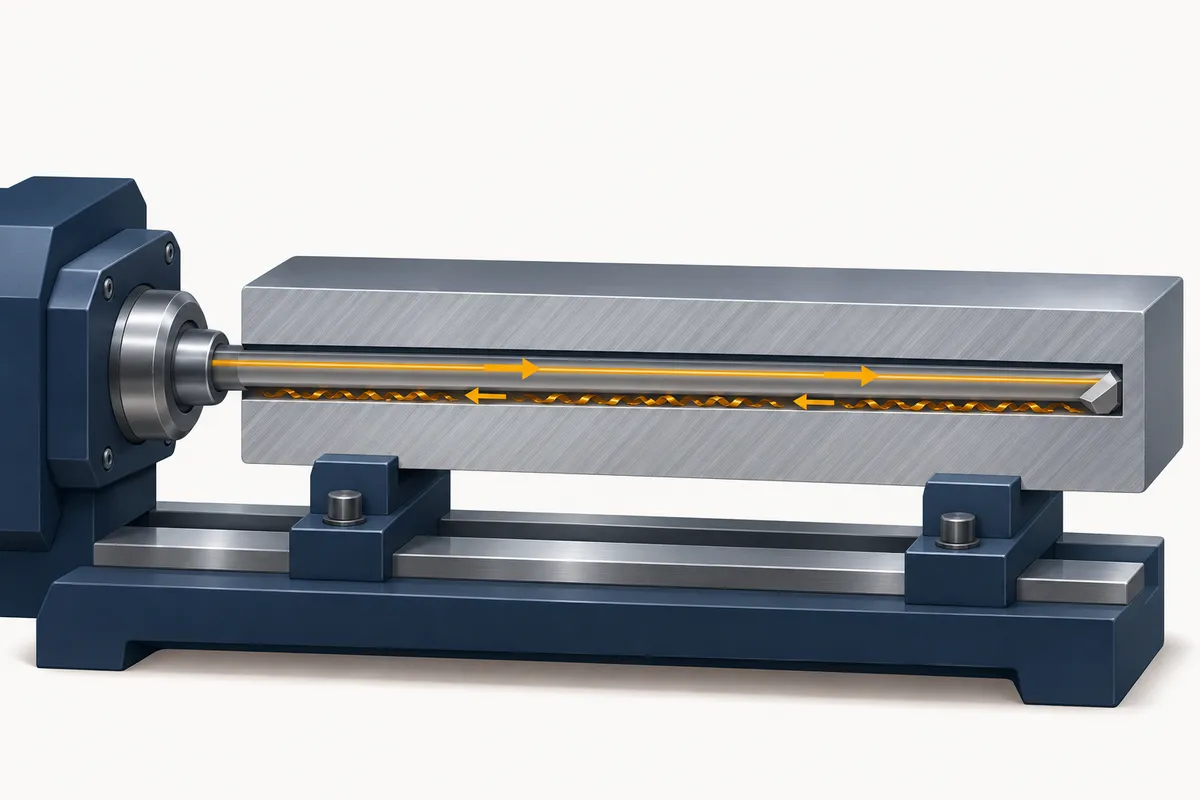
In a very deep, narrow hole the chips of an ordinary drill pack up in its grooves, like digging a deep well with a teaspoon, so it has to keep backing out to clear them. Deep-hole drills pump oil down to the tip at high pressure and wash the chips back out along a groove or through a hollow tube. They can drill holes a hundred times deeper than they are wide, straight and in one go, usually on special machines.
What it is
Beyond roughly 10 to 20 diameters, or where a long hole must stay straight, shops use deep-hole methods. A gun drill has a single cutting edge on a carbide tip, joined to a long tube with a V-shaped groove along its side: coolant at high pressure goes down the inside and washes the chips back out along the groove. It drills diameters from about a millimetre to a few tens of millimetres, can go a hundred diameters deep or more, and starts from a guide bush or a short pilot hole. BTA (or STS) drilling, for larger holes, works the other way round: coolant flows around the outside of the tool and the chips leave through the hollow tube. Both leave a straight, smooth hole that often needs no reaming, and turning the part against the drill helps keep it straight. Typical uses are hydraulic manifolds, mould cooling channels and crankshaft oil holes.
Why it matters for products
Holes are flagged by their depth-to-diameter ratio and priced separately, per millimetre of depth plus setup, often on a dedicated machine or at an outside vendor.
Learn first
Making a part like this? Plan the process and estimate costs in Workspace.