



Counterbores, countersinks and spotfaces
沉孔、沉头孔与锪平
In plain words
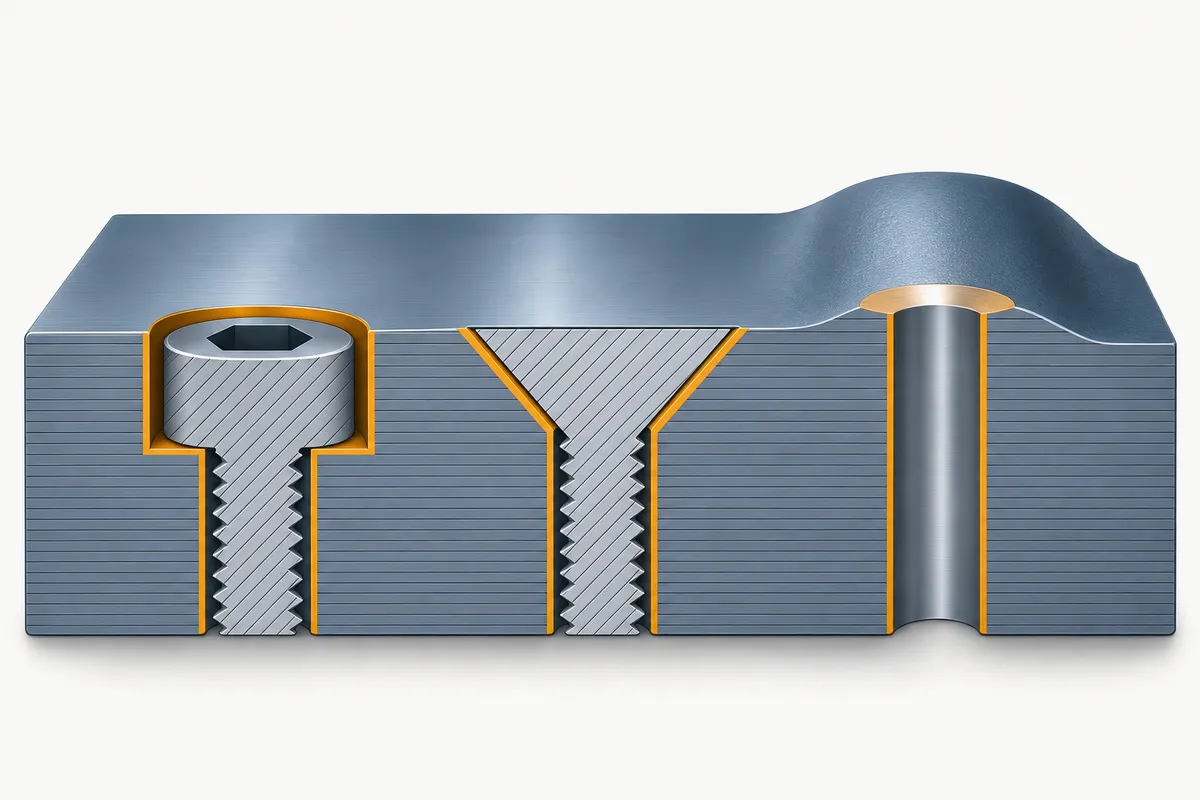
When a screw head must not stick up above a surface, the hole gets a wider step at the top for the head to sink into: flat-bottomed for cylinder-head (socket) screws, cone-shaped for flat-headed ones. A spotface is a shallow flat patch cut on a rough or curved surface so a nut sits square. Each step needs its own tool, so a hole that looks simple can take two or three.
What it is
Three hole forms let fasteners sit properly. A counterbore is a flat-bottomed wider step above the clearance hole, so the head of a socket head cap screw sits at or below the surface; for an M6 screw it is typically a 6.6 mm hole with an 11 mm counterbore about 6.5 mm deep. A countersink is a cone for a flat-head screw, 90° for metric screws and 82° for inch screws. A spotface is a very shallow counterbore that cuts a flat, square seat for a nut or washer on a rough casting or a curved face. Drawings call them up in the hole note with symbols for counterbore, countersink and depth, and standards tabulate the sizes for each screw. They are cut with a counterbore tool, a countersink or chamfer mill, or an end mill moving in a circle; one on the far side needs a back-cutting tool or another setup.
Why it matters for products
Feature recognition should read each as one hole with extra steps, each step adding a tool and time, and match its sizes to a screw table to catch odd ones.
Learn first
Making a part like this? Plan the process and estimate costs in Workspace.