


3D printing process families
3D打印工艺类别
In plain words
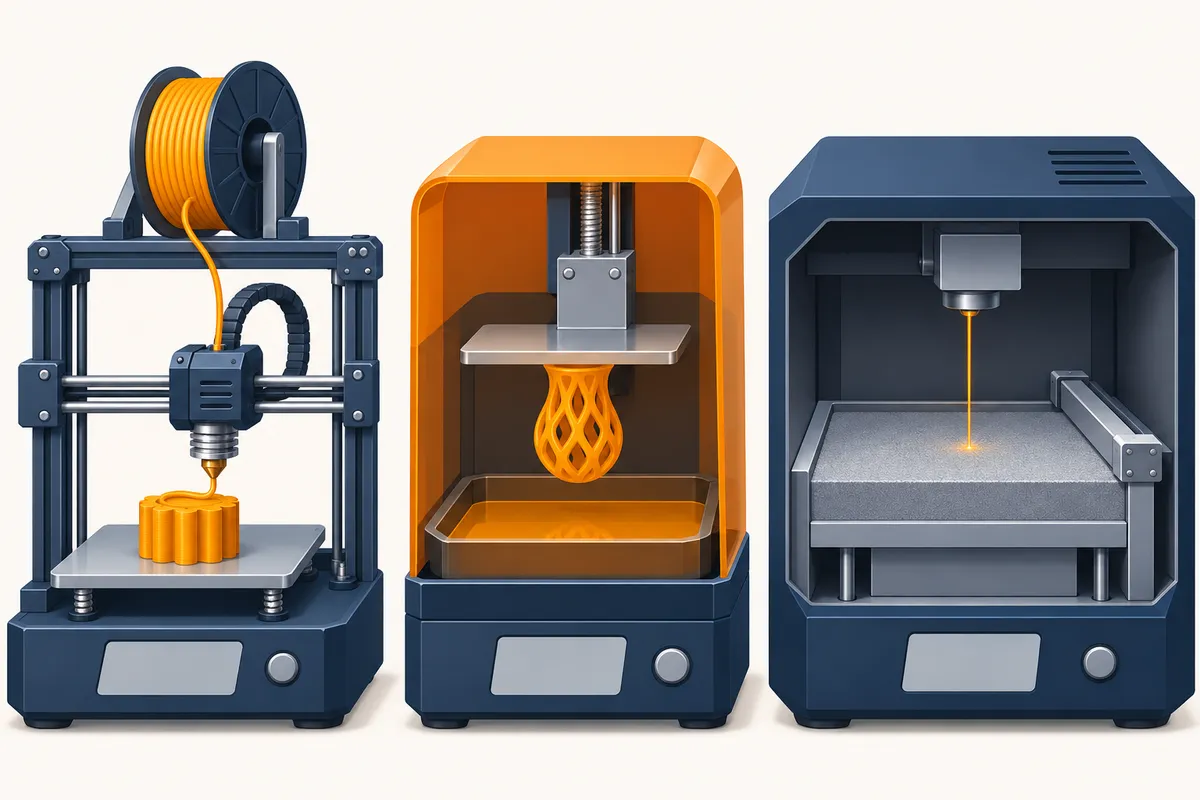
“3D printing” covers several very different machines. Some squeeze out melted plastic like a hot glue gun, some harden liquid resin with light, and some melt a bed of nylon or metal powder with a laser. Each has its own strength, smoothness, accuracy and price, so you pick the one that fits the part, the way you would pick a pencil, a brush or a spray can.
What it is
Buyers choose a printing process, not just 3D printing (154). FDM extrudes melted plastic filament: cheap, strong enough for jigs, with visible layer lines. SLA and DLP cure liquid resin with light: smooth and finely detailed, but more brittle. SLS and MJF fuse nylon powder; the loose powder supports the part, so no support structures are needed, and parts are tough with a slightly grainy grey or dyed-black surface. PolyJet jets resin droplets for multi-colour and soft-touch parts. Metal laser powder-bed fusion (SLM or DMLS) makes dense parts in steel, titanium and aluminium; binder jetting glues metal powder and then sinters it, cheaper per part but with shrinkage. On small parts, tolerances typically run from about ±0.1 to 0.15 mm for resin printing to about ±0.3 mm for SLS and MJF and ±0.5 mm for FDM. Cost follows material, part volume, build height or how many parts share a powder bed, and post-processing: support removal, sanding, dyeing, vapour smoothing and painting for plastics; stress relief, support cutting and machining for metal.
Why it matters for products
Picking the family per part from material, accuracy, surface and quantity, with tolerances quoted per process.
Learn first
Making a part like this? Plan the process and estimate costs in Workspace.